
10 mins read
Seed Phrase vs Private Key: Which Secret Your Platform Actually Depends On
If you are wiring wallet infrastructure into a payment platform for the first time, the first architectural question is which secret your systems ever touch.
A seed phrase and a private key are not two names for the same thing.
A private key signs transactions for exactly one address and controls nothing outside that address.
A seed phrase is a human-readable encoding of the entropy a wallet uses to generate a whole tree of private keys, including keys the platform has not issued yet.
One sits at the root of that tree. The other sits at a leaf.
The cost of collapsing the two shows up in the loss data. Over $3.4 billion in crypto was stolen from January through early December 2025 and attacks on private key infrastructure and signing processes at centralized services accounted for 88% of losses in Q1 2025. Those are platform failures, not user mistakes.
What is a private key in crypto, and what does it control?
What it is
A private key is the secret that produces a valid signature for a single address. It is the unit your signing service actually handles at runtime. CoinWallet treats key-shard import as a distinct import path from seed phrase import, and the derivation relationship is the reason: one secret reproduces an entire tree of keys, the other signs for one address, so they are genuinely different inputs rather than different words for one input.
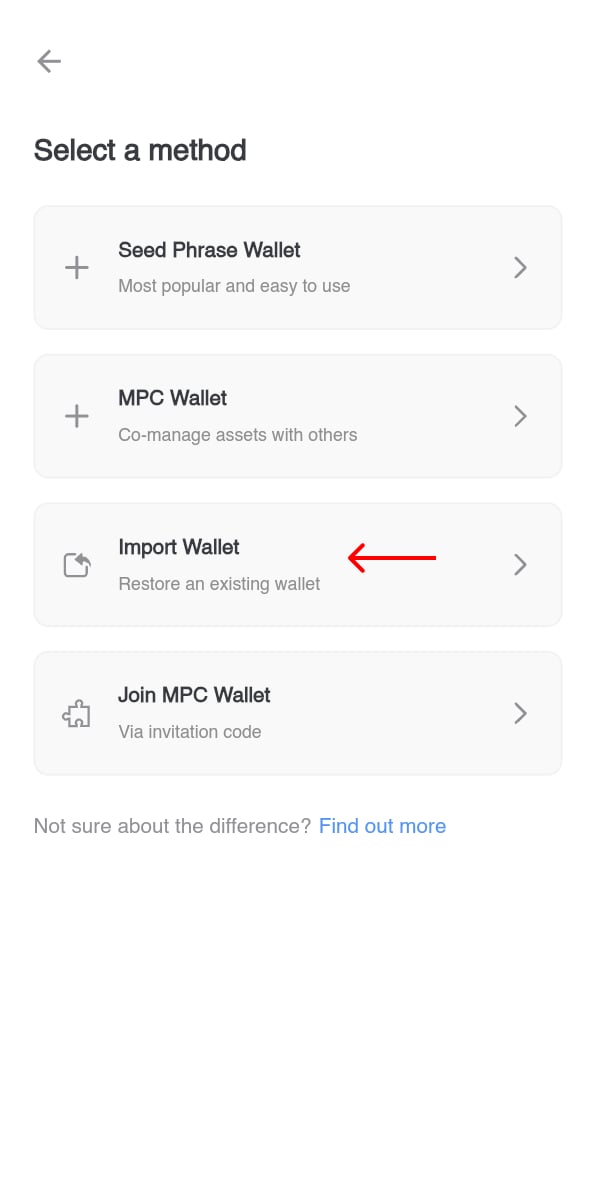
the import method picker showing Seed Phrase, Address Private Key, Key Shard and Keystore as separate options
What it does well
The private key has the narrowest scope of anything in the system, and that is its real strength. A key that leaks costs you one address. A key that rotates costs you one address, one sweep, and one entry in the deposit table. You can hand a single address key to an isolated signing boundary and give that boundary no way to reach anything else. For a platform holding other people's funds, containment is worth more than convenience.
Where teams get it wrong
Teams export one address private key, store it in the vault, and label it the wallet backup. It is not a backup. It is one leaf of the tree. The loss figures above describe the same shape of failure: a signing secret with more reach than the design assumed. For how that plays out in one named incident, see the write-up of the Drift Protocol private key compromise.
How does a seed phrase derive private keys?
What it is
BIP-39, the mnemonic standard, encodes entropy as mnemonic words plus a checksum and stretches that mnemonic into a binary seed. BIP-32, hierarchical deterministic wallets, takes that master seed and deterministically derives a tree of child key pairs, so a single seed reproduces every key beneath it.
What it does well
One artifact restores the entire tree, including addresses issued after the backup was taken. That property is what makes deposit-address generation at scale survivable: you can issue addresses continuously without adding a new backup obligation each time. It also makes the wallet portable between implementations, which matters when you are choosing between a self-custody wallet and an exchange wallet [[internal: /en/blog/self-custody-wallet-vs-exchange-wallet]] at the architecture stage rather than after launch.
Where teams get it wrong
The same property that makes the seed the right backup makes it the wrong thing to keep online. A seed phrase stored where the application can read it gives one database the ability to sign for every address beneath it, current and future. I would treat any code path that can read a mnemonic at request time as a design defect, not a convenience. The definitional detail is covered in the piece on what a seed phrase is and why it is not replaceable [[internal: /en/blog/what-is-a-seed-phrase-and-why-you-should-never-lose-it]].
What does a derivation path actually do?
What it is
A derivation path tells the wallet software which private key to reproduce from the master seed. BIP-44, the multi-account hierarchy, defines the path structure most wallets follow, splitting the tree by purpose, coin, account, change and index.
What it does well
The path is what turns one seed into an address book. Same seed, different branch, different account, and no additional secret to protect. CoinGet builds on exactly this: automated address creation [[internal: /en/coinget]] removes the manual step from onboarding, and the Address Format Validation API, a public endpoint that checks address formats before funds move, shipped in v2.0.24 in April 2026.
Where teams get it wrong
The path is metadata, so it gets treated as disposable, and it is the second half of the backup.
Without it: a team rebuilds a signing host after a hardware failure. The runbook said back up the key, so the on-call engineer restores the one exported address private key sitting in the vault. The service returns, signing for one address. Every other deposit address issued that quarter is still on chain, still holding balances, and nothing in the vault reproduces them.
With it: the same rebuild, where the vault holds the mnemonic and the account and index range in use. The restore reproduces every address the platform ever issued, in order, and reconciliation against the deposit table finishes before standup.
Seed phrase vs private key: when is the seed phrase the secret that matters?
The seed is the deciding secret when any of these are true:
- You need to reproduce addresses the platform issued but no longer has records for.
- You are rebuilding wallet infrastructure from nothing after a total loss of hosts.
- You are migrating between wallet implementations and need the same addresses on the other side.
- You are deciding what goes into offline or split custody, covered further in hot versus cold wallets for institutions [[internal: /en/blog/hot-vs-cold-wallet-for-institutions]].
- You are writing the disaster recovery runbook and need one artifact that restores the whole tree.
Seed phrase vs private key: when is the individual private key the secret that matters?
The individual key is the deciding secret when any of these are true:
- You are signing a specific withdrawal and want the signing boundary to hold nothing broader.
- You are containing a compromised hot address without touching anything else.
- You are rotating an address on a schedule and want rotation to stay cheap.
- You are giving a third party temporary signing ability over one address and nothing more.
- You are scoping an audit and need to state exactly what a given service can sign for.
Which secret should the platform hold, back up, and never write down?
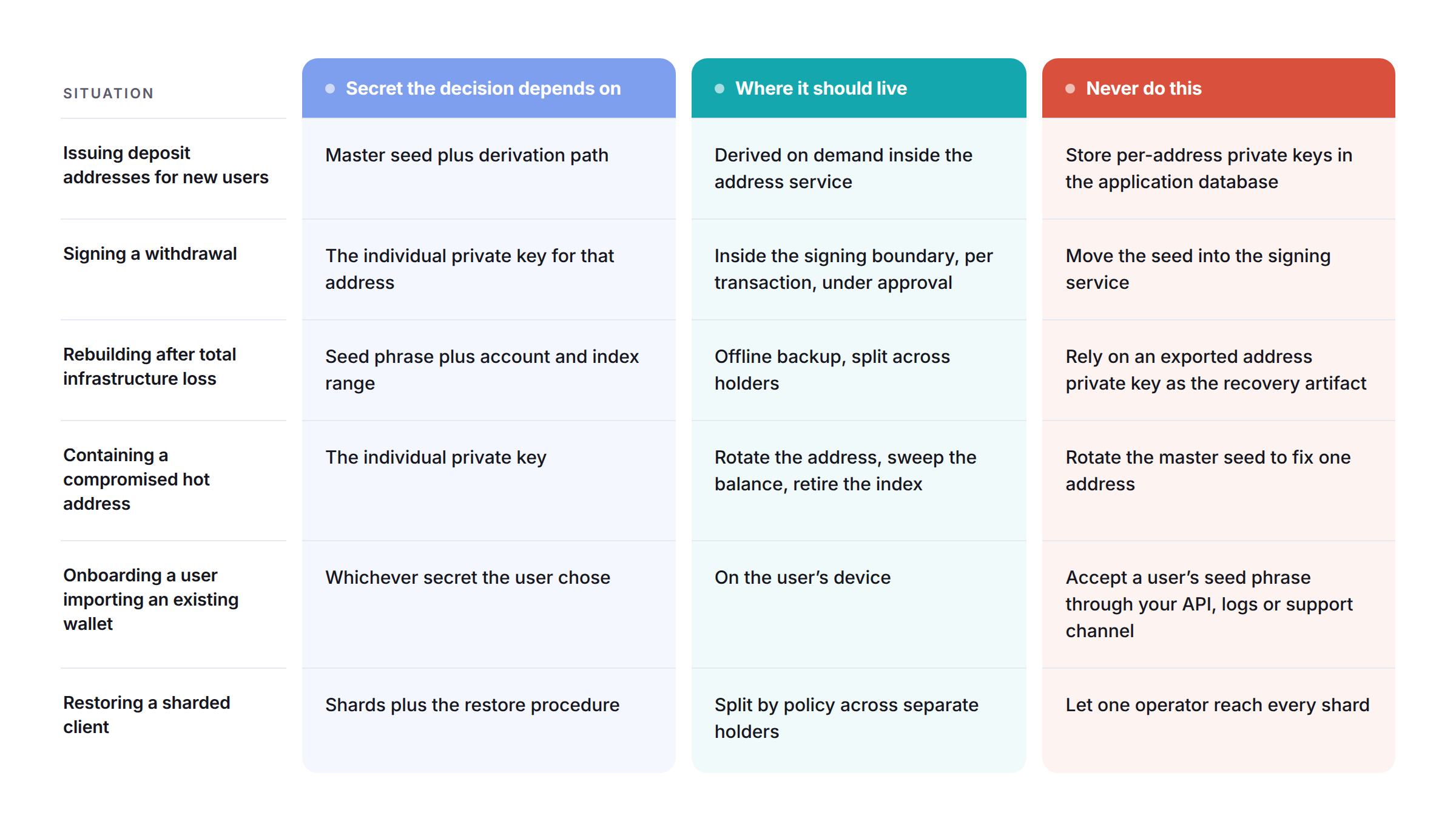
The verdict: back up the master seed and the derivation path, and rotate at the address level. Neither secret is written down anywhere your application can read, and a user's seed phrase never enters your systems at all. Backing up a single private key protects one address and loses every other key in the tree, which is the failure that only surfaces during a restore, when it is too late to fix.
If you want a signing model where no single artifact reconstructs the root at all, CoinWallet supports MPC wallet creation and threshold-gated device replacement, explained in the beginner's guide to MPC wallets.
What else do engineers ask about seed phrase vs private key?
Is a seed phrase the same as a private key?
No. A seed phrase encodes the entropy that generates a tree of private keys, and a private key signs for one address. The seed sits above every key derived from it, so losing the seed loses the whole tree.
Can a private key be turned back into a seed phrase?
BIP-32 defines derivation in one direction, from a master seed down to child key pairs. Nothing in the standard defines the reverse. Recovering a seed from one exported private key is not part of the specification, so plan backups around the seed.
What is a derivation path used for?
A derivation path names the branch of the key tree a wallet should reproduce. BIP-44 defines the multi-account hierarchy most wallets follow. Without the path and index range, a restored seed can regenerate keys the platform never issued and miss ones it did.
Should a payment platform store customer seed phrases?
No. A stored seed phrase gives one database the ability to sign for every address beneath it. CoinsDo never holds your private keys, and the same rule belongs in your own architecture: derive on demand, store nothing that reconstructs the root.
What happens when one private key is compromised?
Rotate at the address level. Sweep the balance to a freshly derived address, retire the compromised index, and leave the seed untouched. Rotating the master seed to contain a single address failure moves every other address for no benefit.
Which secret should a platform back up first?
The master seed, together with the derivation path and the account and index range in use. That pair reproduces every address the platform issued. An exported address private key restores one address and proves nothing about the rest.
Next step
Write the two lines into your architecture doc before the integration starts: what the platform derives on demand, and what exists only in offline backup. If you want the wallet layer built so those two lines stay true under load, see how the CoinsDo WaaS stack handles key custody