
13 mins read
Crypto Treasury Governance: How to Structure Tiered Approval Workflows at Scale
Your approval thresholds were set the week you launched.
Back then a $50,000 ceiling for single-signer withdrawals felt cautious, maybe even paranoid. Daily volume was a fraction of what it is now.
Two years later you clear nine figures a day, the same threshold still sits in your config, and the gap between what your governance assumes and what your treasury actually moves has quietly become the largest unmanaged risk on your books.
Nobody decided to let it drift. It drifted because nothing forced a review.
Structuring Tiered Approval Workflows for Institutional Scale
A working withdrawal approval workflow uses three dollar tiers, not one blanket rule.
- Below a defined floor, low-value withdrawals clear through automated dispatch so routine volume never queues behind a human.
- Between the floor and a ceiling, every withdrawal needs two independent authorizers.
- Above the ceiling, a multi-sign committee signs off.
The ceiling is reviewed every quarter against average daily volume so the model tracks the business instead of freezing at launch settings.
The rest of this guide is how to set each boundary, who holds authority at each tier, and how to run it with configurable wallet infrastructure rather than a workflow engine you have to build and maintain yourself.
The Institutional Impact of Governance Gaps
In 2021, Bybit lost about $1.5 billion of ether in the largest crypto theft on record, and the funds left during a routine transfer when attackers manipulated the multisig signing interface so signers approved a transaction that did not match what they believed they were authorizing.
The signers followed a flawed process, which is the lesson worth sitting with: the loss came from an approval step that signers could not verify against what they were really signing. A governance model that adds more signatures without giving each signer a trustworthy view of the transaction adds ceremony, not safety.
Tier design has to carry both: who signs, and whether what they see is what they sign.
Core Principles of Enterprise Treasury Governance
Threshold-based approval governance works because it matches the level of human scrutiny to the size of the risk.
Small withdrawals dominate transaction count but carry trivial individual exposure, so forcing two officers to review each one wastes the exact attention you need for large ones.
Large withdrawals are rare but carry concentrated loss potential, so they earn committee-level review.
A single blanket threshold gets both wrong at once: it either throttles routine flow or it waves through transactions large enough to matter. Tiering separates the two problems and solves each on its own terms.
Segregation of duties is the principle underneath it. No single person should be able to both initiate and release a high-value transfer. Approval thresholds put a number on where that separation kicks in. An audit trail proves it held.
Any treasury lead who has sat through a SOC 2 review or a banking-partner due-diligence questionnaire already recognizes this triad, because it is the same control structure that governs wire transfers in regulated finance.
Tier 1: Operational Efficiency via Automated Dispatch
The floor is the line below which a withdrawal needs no human approval at all. Set it where the per-transaction loss from a bad release is small enough that catching it through monitoring after the fact costs less than reviewing every transaction before the fact.
For most exchanges in the $10M to $500M daily range, that floor sits somewhere between $1,000 and $10,000, though the right number depends on your fraud rate and your monitoring coverage, not on a rule of thumb.
Below the floor, speed is the point. Customers expect withdrawals to land in seconds, and routine volume should never wait in an approval queue. CoinSend handles this tier with instant, automated withdrawals running 24/7, so the high-count, low-value traffic that makes up the bulk of your transactions clears without a human in the loop.
The control here is not pre-approval. It is the floor itself, plus the monitoring that watches the aggregate. Keep the floor low enough that an attacker cannot drain meaningful value through a flood of sub-floor withdrawals, and revisit it whenever your fraud signals shift.
Tier 2: Dual Authorization and Segregation of Duties
Between the floor and the ceiling sits the bulk of your governed value: withdrawals large enough to demand review, frequent enough that a committee would create a bottleneck. This is the dual-authorization tier.
Every withdrawal in this band needs two independent people to sign, one to initiate and a second to verify and release, and the two roles must never collapse into one person.
CoinSend's custom approval flows let you define this band directly: reviewer tiers, thresholds, and escalation logic for high-value transactions, configured rather than coded.
Sub-account role management gives each authorizer a granular role, so the person who initiates a mid-range withdrawal is structurally separate from the person who releases it, and the main account controls each sub-account's login session validity. The second signer is the control, but only if the second signer can trust what they see.
CoinSign carries the authorization itself: bank-grade digital signatures using RSA and HMAC-SHA256, with cross-platform review across mobile, PC, and browser extension, producing an unforgeable authorization trail for every approval. The signature is bound to the transaction, which is the property the Bybit signers did not have.
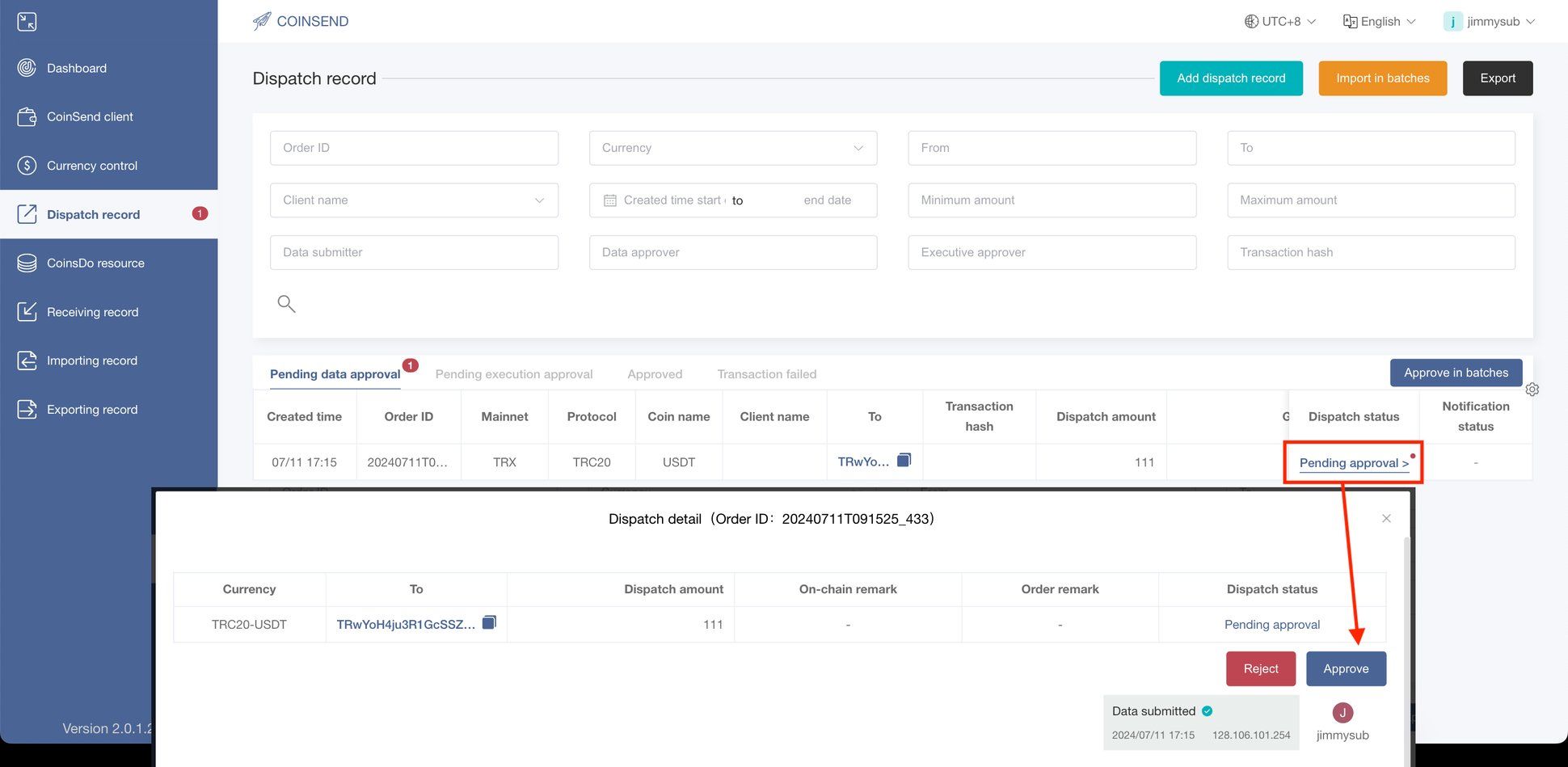
approving a transfer with reviewer and second-signer authorization
Set an expiry on every dispatch record in this tier. An approval that sits open indefinitely is a standing liability, because circumstances change between when a withdrawal is initiated and when it clears.
CoinSend's approval expiry controls let you configure expiry per dispatch record, so a mid-range withdrawal that does not clear inside its window lapses and has to be re-initiated rather than releasing against stale authorization.
Tier 3: Multi-Sign Committee and Institutional Safeguards
The ceiling is the line above which a single pair of authorizers is no longer enough. Above it, withdrawals require a multi-sign committee, typically three or more designated signers drawn from treasury, finance, and a security or leadership function. These are the movements large enough that a compromised pair of credentials, or two colluding insiders, should not be able to release them.
Set the ceiling as a function of your average daily volume, not as a fixed number. A defensible starting point is the level at which a single withdrawal represents a material fraction of a normal day's outflow, the size at which you would want your CFO to know before it left, not after. For an exchange clearing $100M a day, that ceiling lands far higher than for one clearing $10M, which is exactly why a static threshold drifts out of alignment as you grow.
Committee approval runs on the same CoinSend and CoinSign mechanics as the mid tier, with more required signers and roles drawn from a wider function set. Each committee member reviews and signs across their own device, mobile, PC, or browser extension, and every signature lands in the same authorization trail.
Authorizing a sub-account into the committee, with its own data and approval rights, follows the same role-management path.
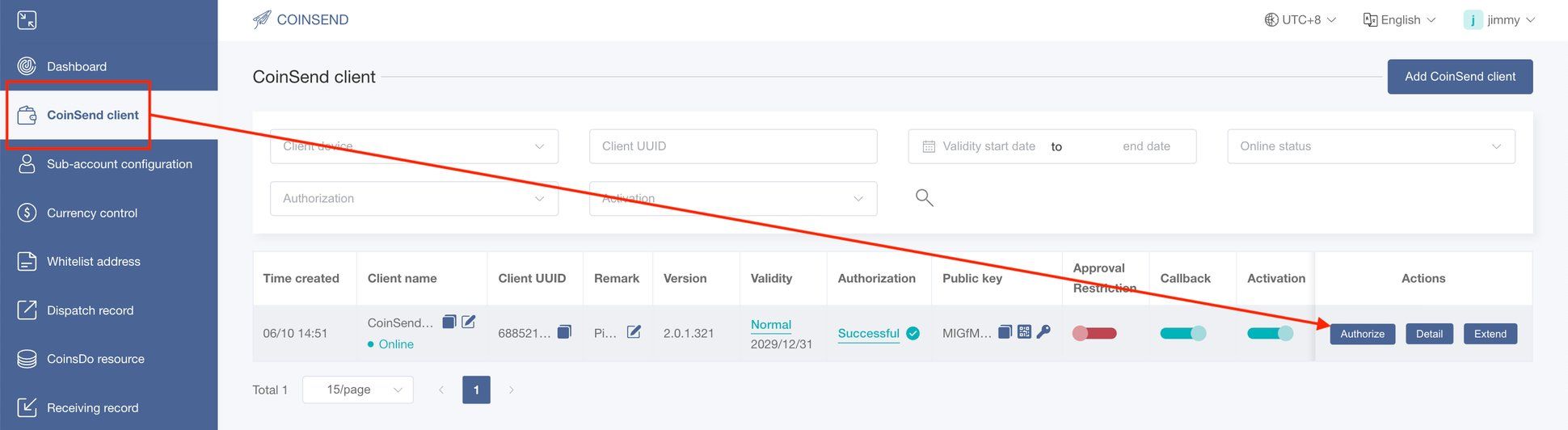
authorizing a sub-account with data and approval rights for committee signing
Comparing Governance Models: Static vs. Tiered
Picture a treasury team running a single $50,000 single-signer threshold inherited from launch.
A withdrawal request for $400,000 comes in during a busy afternoon. It clears the only check there is, one officer's approval, because nobody ever built a tier above it. The officer is rushed, the request looks plausible, and there is no second signer and no committee because the governance model never contemplated a withdrawal that size.If the request is fraudulent or compromised, the first time anyone with authority sees it is in the post-incident review.
Now picture the same team on a three-tier model. The $400,000 request lands above the dual-authorization floor, so it needs a second independent signer before anything moves. If it is also above the committee ceiling, it routes to multi-sign, where three people across treasury, finance, and security each review the bound transaction on their own device and sign.
The fraudulent request now has to defeat three independent reviewers looking at a signature trail they can verify, instead of one rushed officer looking at a threshold that stopped reflecting reality two years ago.
Institutional Governance Decision Matrix
Use this as a starting structure and tune the boundaries to your own volume and risk profile.
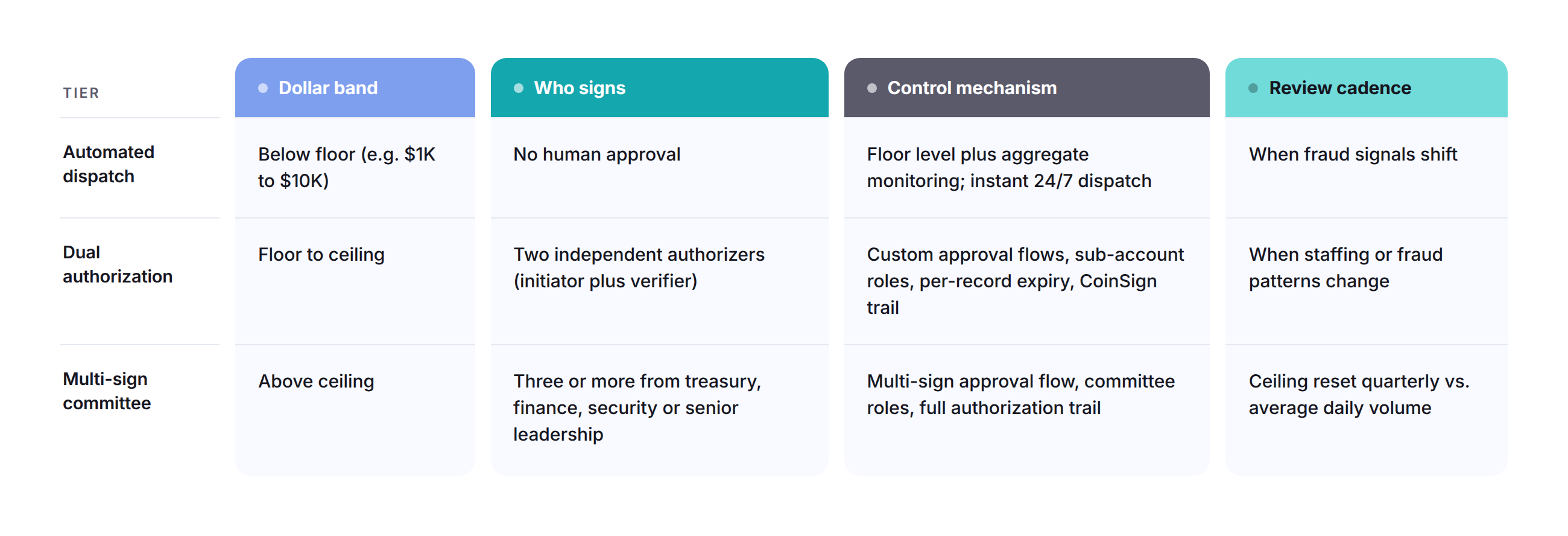
A few rules hold across every tier. One person should never both initiate and release the same governed withdrawal. Every approval above the floor should produce a verifiable signature bound to the transaction, not just a click. Every pending approval should carry an expiry. And the ceiling specifically should be on a quarterly calendar with a named owner, because it is the boundary that drifts.
The platform underneath this matters as much as the tiers. You control your keys, CoinsDo never holds your private keys, and the whole system is API-first, so the approval model lives in wallet infrastructure you own rather than in a custodian's policy you cannot see.
For the wider context on how this fits an institutional withdrawal stack, see the breakdown on automating user asset withdrawals for blockchain institutions and the hot vs cold wallet comparison for institutions.
Frequently Asked Questions on Treasury Governance
What is a crypto exchange approval workflow?
It is the set of rules that decides who must sign off before an outbound withdrawal clears. A tiered version routes withdrawals by dollar amount: automated dispatch below a floor, two authorizers in the mid band, and a multi-sign committee above a ceiling.
How many approval tiers should an exchange use?
Three works for most exchanges: an automated tier below a floor for routine low-value volume, a dual-authorization tier for mid-range withdrawals needing two independent signers, and a committee tier above a ceiling for the largest movements. More tiers add friction without adding meaningful control.
Where should the withdrawal approval thresholds sit?
The floor goes where per-transaction loss stays small enough to catch through monitoring. The ceiling pegs to average daily volume, set where one withdrawal is a material fraction of a normal day's outflow. Both depend on your volume and fraud profile, not a fixed industry number.
How often should approval thresholds be reviewed?
Review the ceiling quarterly against trailing average daily volume, since that is the figure that grows while your config stays static. The floor and dual-authorization band change less often, usually only when fraud patterns or staffing shift. Assign a named owner to the quarterly review.
Does adding more signers make withdrawals safer?
Only if each signer can verify what they are signing. The Bybit signers followed the process and still approved a transaction that did not match what they saw. Signatures bound to the transaction, like CoinSign's RSA and HMAC-SHA256 trail, are what make extra signers add safety rather than ceremony.
Can you run tiered approvals without building a workflow engine?
Yes. CoinSend's custom approval flows let you configure reviewer tiers, thresholds, and escalation logic directly, with per-record approval expiry and CoinSign authorization, so the three-tier model runs on configurable infrastructure rather than a custom engine you have to build and maintain.