
15 mins read
UTXO Consolidation on Bitcoin: Who Holds the Keys During the Sweep?
You generate a deposit address per user, so your Bitcoin wallet holds a small output for every customer who has ever funded an account. Each sweep spends all of them, and the bill grows with your user count even when the amount of bitcoin stays flat.
UTXO consolidation is the act of spending many small outputs into one larger output so that later withdrawals spend fewer inputs. On Bitcoin the cost of a transaction tracks its size in vbytes, and inputs are the dominant term in that size. A wallet holding one deposit address per user pays that input tax on every spend until the set is consolidated.
The decision that shapes everything else is who signs the consolidation, because a sweep across hundreds of addresses is hundreds of authorisations happening at once.
A custodian will frame UTXO management as a fee problem, because fees are the only part of it you can see from outside their perimeter. Sats per vbyte is the answer to a smaller question.
What is UTXO consolidation and why does its cost grow with your user count?
Bitcoin has no balances. A wallet is a pile of discrete outputs, and spending means selecting some of them as inputs to a new transaction. Consolidation selects a lot of them at once and pays them back to yourself.
The price of that is structural. The published field sizes give every input a 36-byte outpoint, a scriptSig length field of 1 vB for short scripts, a 4 vB nSequence, and a 0.25 vB witness item count in a segwit transaction. Witness data adds 27 vB for a P2WPKH input and 16.5 vB for a taproot key-path input. A P2WPKH input costs roughly 68 vbytes and a taproot key-path input costs roughly 58 vbytes. A P2WPKH output is 22 bytes of scriptPubKey and a P2TR output is 34 bytes.
Read those two groups next to each other and the whole economics of a deposit business falls out. Outputs are cheap. Inputs are the bill. On Bitcoin a consolidation transaction's size in vbytes is driven mostly by how many inputs the transaction spends, and the amount of bitcoin moved makes no difference to it at all. Which script type your deposit addresses use changes the per-input figure by about ten vbytes, which is why the choice is worth making deliberately; we covered what a SegWit address changes for a business wallet separately.
Some scale for the shape of the problem. The UTXO set report counted 173 million UTXOs in the Bitcoin set at block 892,385 taking around 11 GB on disk. 49.1% of those UTXOs held less than 1,000 satoshis, and inscription-related outputs made up 29.6% of the set, 51,188,145 of 173,190,861. Those are network-wide figures. Your own wallet is one slice of them, and the slice a per-user deposit design produces looks a lot like the average: many outputs, most of them small.
Why a deposit address per user turns consolidation into a signing problem
One address per user is the right call for reconciliation. It is how you tell whose money arrived without asking the user to attach a memo, and it is the same argument we made about matching incoming funds to invoices in our guide to deposit address reconciliation.
The cost lands somewhere else. Every one of those addresses has its own key. A sweep that spends from five hundred of them needs authorisation from five hundred keys inside one transaction build, and that is a very different event from a single withdrawal from a treasury address.
Without a rule, consolidation becomes a project. Someone in operations picks a quiet weekend, pulls a list of addresses carrying dust, and walks the whole set through a signing process that was designed for a handful of withdrawals a day. Keys that normally sit offline come online for the duration. The exposure window is however long the job takes, and the job takes longer every quarter.
With a rule, consolidation is a job that runs against a threshold you set and signs the same way every time. The exposure window stops growing with your user count, because the thing that scales is the input count, and the thing that stays fixed is the signing path.
That distinction is the custody question, in the plainest form it takes. A wallet is custodial or non-custodial based on who can produce a valid signature, and the answer changes during a sweep if your sweep design makes it change. Our comparison of hot and cold wallet setups for institutions covers where each side of that line is worth defending.
What UTXO consolidation costs and why nobody publishes the number
No vendor, custodian or exchange publishes what a business running one deposit address per user pays annually to consolidate its UTXO set. There is also no published industry figure for how many signing operations a sweep across N deposit addresses requires.
That absence is worth sitting with for a second, because it is the reason most UTXO management content is about fee charts. You can compute your own figure from the mechanism above in about ten minutes: count the inputs the sweep will spend, multiply by the per-input vbyte cost for your script type, add the output and overhead, and price it at the rate you would accept. The number you get is real and it is yours. A vendor quoting an average is quoting something else.
The second number has no shortcut. Count the distinct addresses that enter a sweep and you have counted the keys that must authorise it. If that count is uncomfortable, the sweep design is the thing to change, and the build versus buy trade behind it is the one we worked through in our comparison of wallet-as-a-service and in-house builds.
How to decide what triggers the sweep
Take the three decisions in this order: the rule, the signer, the fee. Most teams arrive with the fee decision already made and the other two unexamined, which is how a business ends up with a cheap sweep that puts keys somewhere it would rather they were not.
The rule comes first because it fixes when the event happens, and the whole point is that a person no longer chooses. A rule can fire on elapsed time, on a balance threshold, or on a condition you define for your own flow.
Auto-Collection in CoinGet, our deposit engine, consolidates assets from multiple addresses into main wallets based on time, balance, or custom rules. The collection address configuration offers two modes. Rotation mode transfers collected assets to the designated collection addresses in rotation.
Limitation mode transfers based on quota limits defined per collection address, checking each address in order and skipping to the next when one exceeds its quota.
If all collection addresses exceed their limits, the system does not proceed with the collection. A quota system that silently spills over into the last address standing would concentrate funds exactly where you told it not to. Failing closed is the behaviour you want from an automated sweep.
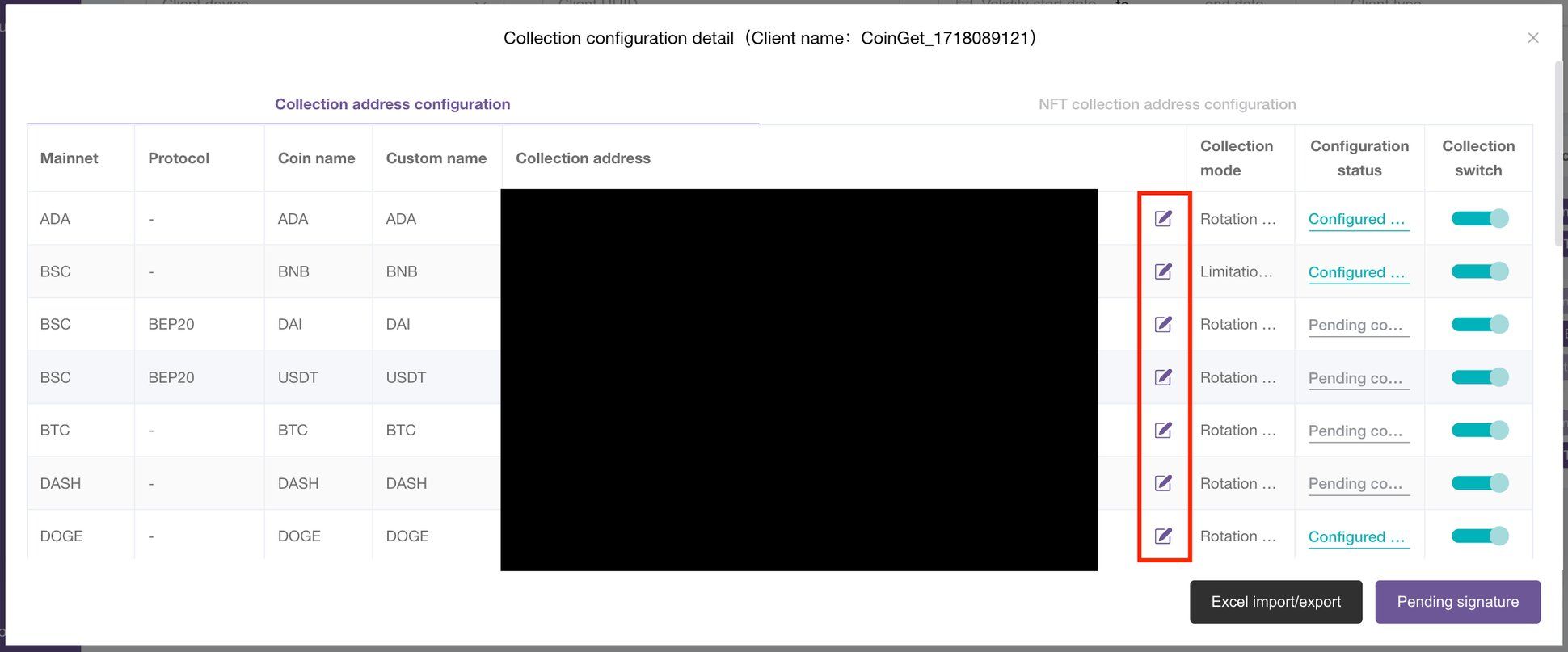
Rotation and limitation mode settings for collection addresses
Rules leave a remainder. Balances that never reach the threshold sit where they are.
Manual collection covers that case. The operator inputs the desired collection amount and submits, and the result appears in the Collecting record page. Keep manual collection for the remainder and nothing else. A manual sweep that runs on a schedule is a rule someone forgot to write down.
How to decide who holds the keys while the sweep is signed
This is the decision a custodian answers for you by default, and the answer is that they hold them.
CoinsDo never holds your private keys, and you maintain full control of your private keys. In a consolidation that matters more than in a withdrawal, because the withdrawal touches one key and the sweep touches every deposit key in scope at once.
Two mechanisms carry that on the CoinsDo side. The CoinGet client is available in a sharded-key configuration with restore support, so the signing material is split, and no single process holds it whole; restoring an old client is documented, and the key-shard configuration page itself is not yet published. This configuration is key-shard. It is not MPC.
The second is that the configuration change is itself a signed event. Submitting a collection configuration change produces a QR code that must be scanned and signed in the CoinSign app with the client password and the client Google code. CoinSign is a feature of CoinSend, our withdrawal dispatch product, and its signatures are RSA and HMAC-SHA256. So the rule that moves your money cannot be changed by whoever has a dashboard login.
Collected funds can then be routed onward automatically to cold storage, which is the part of the design that decides how long anything sits in a warm address after a sweep completes. If you are assembling this layer from scratch, our overview of wallet-as-a-service architecture sets out what the rest of the stack has to provide around it.
Here is the judgment. If a provider quotes you a consolidation saving in sats per vbyte and cannot tell you which machine holds the key at the moment of signing, the quote answers a question you did not ask. Ask the second one and watch what happens to the conversation.
Talk to us if you want that question answered against your own address count.
Why Bitcoin sweeping works differently from token sweeping on account-model chains
Multi-chain deposit habits often break down when applied to Bitcoin.
On account-model chains, token sweeping requires the receiving address to hold native tokens for gas. CoinGet handles this via gas fee addresses, which are standby addresses created per blockchain to top up receiving addresses lacking sufficient gas. The CoinGet client estimates the gas fee via the CoinsDo server and transfers the required funds before executing the sweep. Balances in gas fee addresses can later be withdrawn to the main collection address.
Bitcoin operates differently: transaction fees are deducted directly from the spent inputs, eliminating the need for top-ups or standby gas balances. Features like automatic transaction acceleration apply only to EVM collection and have no Bitcoin equivalent.
Consequently, Bitcoin sweeps depend uniquely on input counts, which compound fees over time. As entry 12 on CoinsDo's supported blockchain list, Bitcoin is the primary chain where per-user deposit architectures carry a direct, scaling fee burden.
What to check before you run your first consolidation
Most UTXO management guidance stops at fee timing. Run these first.
- Count the inputs your next sweep would spend and price them at the per-input vbyte figures above, so you know what the transaction actually costs before anyone quotes you a saving.
- Confirm which script type your deposit addresses use, because the per-input difference between P2WPKH and taproot key-path compounds across every future spend.
- Write down where the signing material lives during a sweep and how long it is reachable, then compare that window against your current withdrawal process.
- Set the collection rule and the collection address quotas before the first run, and confirm the behaviour when every collection address is at its limit.
- Decide who can change that rule, and confirm the change requires a signature, since a dashboard login on its own should not be enough.
- Keep manual collection for balances the rule will never reach, and check the Collecting record page after each manual sweep.
- Check that deposit addresses shown to users are verified as legitimate before funds ever arrive, since a redirected deposit address is a consolidation problem you will never get to solve.
If your current provider cannot give you a straight answer on more than two of these, that is the shortlist conversation, and our review of wallet-as-a-service providers is the place to start it.
UTXO consolidation questions from engineering teams
What does UTXO consolidation actually do to a Bitcoin wallet?
UTXO consolidation spends many small outputs and produces one larger output. The wallet's balance stays the same. What changes is the input count of every future withdrawal, which sets the vbyte size, and therefore the fee, of everything you spend afterwards.
When is the best time to consolidate a UTXO set?
Consolidate when the fee market is quiet and your operational need for the funds is low. The saving is the difference between today's rate and the rate you would pay spending the same inputs during a busy period later.
Does consolidating UTXOs hurt privacy for a deposit business?
Consolidation links the addresses it spends from, because every input in one transaction is publicly tied to the others. A business running a deposit address per user has already accepted that linkage internally. Decide whether your users have.
How many signatures does a multi-address consolidation sweep require?
No published industry figure covers signing operations per sweep. Work it out from your own wallet: the number of distinct addresses entering the sweep is the number of keys that must authorise it, and that number grows with your user count.
Can a custodian consolidate UTXOs without holding my keys?
A custodian consolidates with keys it holds, which is what makes it a custodian. CoinsDo never holds your private keys, so consolidation runs as a signing event on your side, with CoinGet generating the deposit addresses and sweeping them under rules you set.